
A Sand Bathing Owl
Updated: Mar 4
We went out to one of our favorite coastal California tracking spots over the weekend and found a gorgeous display of Great Horned Owl tracks in the sand dunes, accompanied by multiple sand bathing spots.

Owls, along with many other birds and mammals, bath in dust or sand to take care of their skin, fur and feathers as it helps remove excess oil and parasites. They spread their wings and flap, wriggle and role in the dirt to coat their feathers. This is often followed by vigorous shaking to ruffle the feathers, and preening. (Wikipedia)


Perfect tracks stitched together the sand bath spots. Owls have zygodactyl feet, meaning the first and fourth toe point backward. An Owl's fourth toe is 'reversible' — it can actually point forward or backward (unlike other birds with zygodactyl feet).
You can see in the photo how the fourth/outer toe points to the side while walking. That fourth toe will point backward (so two toes pointing forward and two pointing backward) when catching prey to secure a tight grip.

At one point, the Owl's trail took a sudden, sharp left!
Something had clearly grabbed their attention...
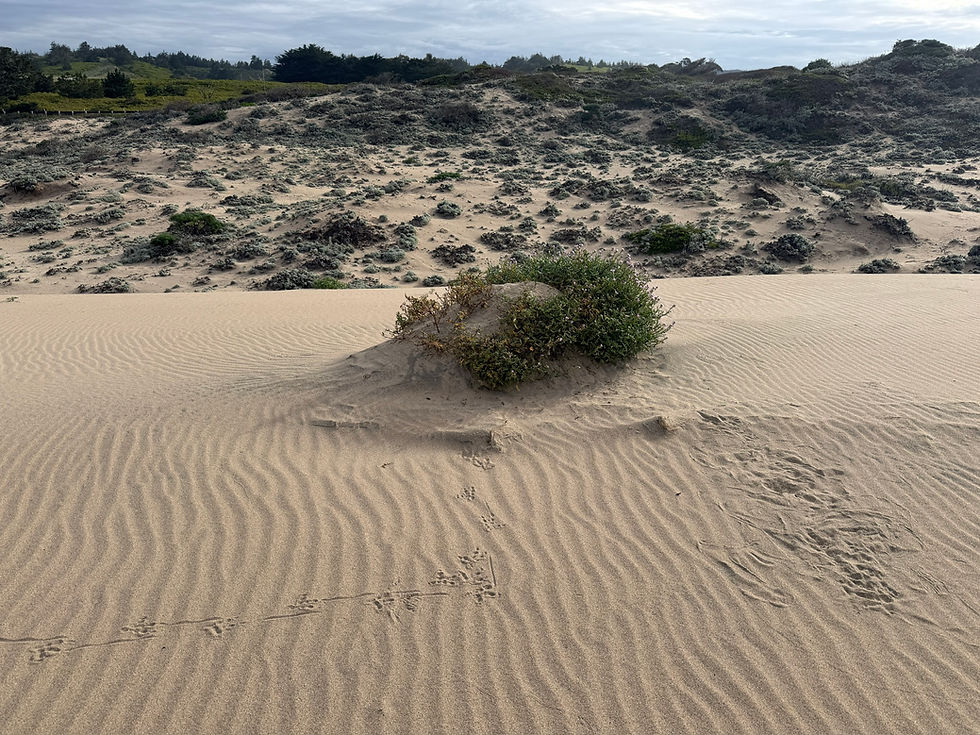
A good view?! The Owl's tracks led to the top of a mound of vegetation, then back down to the sand for another romp. It's super fun to imagine this Owl walking around in the middle of the night under the almost full moonlight, taking bath after bath. How long did they spend doing this? Maybe 30, 40 minutes, or more? We imagined them to be truly enjoying the experience — a refreshing and rejuvenating spa night :)
More sand baths and tracks.
Another interesting note, just three weeks prior we had come across the very same signs in the sand, in the very same spot, of a Great Horned Owl sand bathing! Is it the same Owl? Is this a well known 'Owl spa', frequented by other local Owls? And why this place? What makes an Owl want to dance around in the sand here, specifically?

Well, it is a pretty cool spot: a flat expanse atop the rolling dunes with very little vegetation and a good view of the surroundings. It would be much harder for someone like a Bobcat to sneak up on you while bathing, as compared to the more vegetated, rolling dunes that are around. There is just something inviting about the open, flat space that even we feel in our human bodies.
Rodent trails through vegetation and up a hill. These trails are everywhere in this area!
Also, this area in general has a very healthy rodent population! A larder for the Owls. I love to imagine getting full on my favorite meal, having ample spa time, and heading to roost for a satisfying slumber. Seems like perfection to me.


